
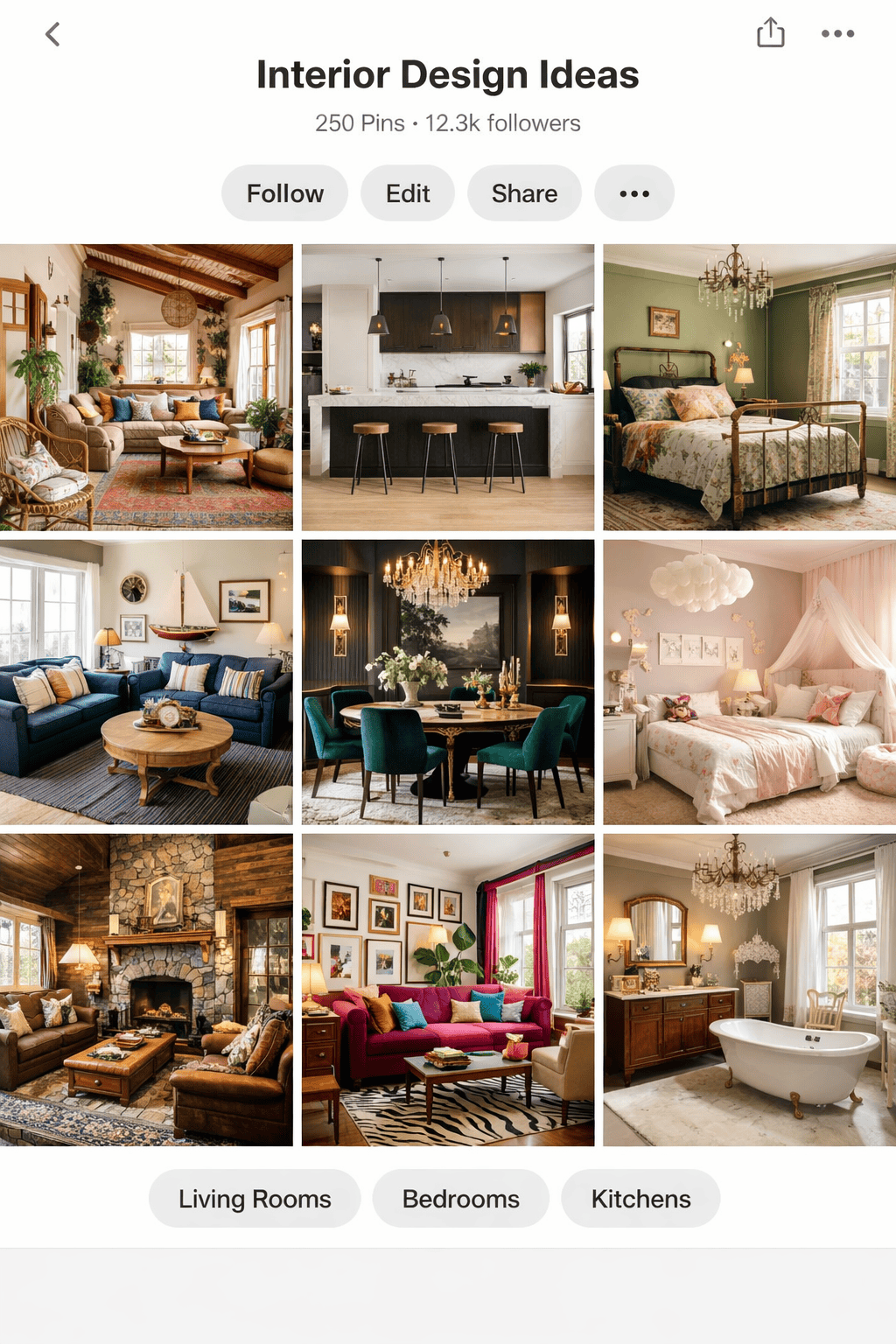
Have you ever opened one of your Pinterest boards and thought, “Wait… what is my style, actually?”
You scroll and see a light, airy living room. Then a dark, moody one. Then a cozy cottage kitchen. Then something sleek and modern. You like all of it. And yet somehow, none of it feels like a clear direction.
It can start to feel like you don’t have a style at all. That’s usually not the problem though.
You’re pinning feelings, not floor plans
Most of us don’t pin strategically. We pin emotionally.
You see a room and think, “That feels calm.” Or, “I love that.” Or, “I wish my house felt like that.”
So you save it.
What you’re responding to might not be the furniture layout or the cabinetry style. It might be the natural light. The editing. The lack of clutter. The fact that it’s professionally styled and photographed.
When you put ten of those images together, they all gave you a good feeling in the moment. But they might not share the same bones underneath.
So your board feels cohesive emotionally…and confusing visually.

You’re mixing real life with fantasy life
Pinterest is also where we pin for a dream life…or 7.
You might pin a super minimal living room with one chair and a single branch in a vase. It’s beautiful. It looks peaceful. But would you enjoy keeping it that empty every day?
You might love a romantic English cottage bedroom, and also a modern, high-contrast office. Both can be beautiful. But they don’t usually belong in the same house.
Sometimes your board feels scattered because it’s you’ve pinned both who you are and who you dreamed of being for a few minutes on Tuesday night.
Totally normal! And doesn’t mean you don’t have taste. It just means you haven’t filtered it yet.
So what do you actually do about it?
- Stop adding to the board for a little while.
This sounds small, but it changes things. When you stop reacting and start observing, you can see your board more clearly. - Go back and pay attention to which images still feel right. Notice which ones feel flat or random now. Time has a way of editing.
- Start looking for repetition.
Are most of your favorite spaces lighter or darker? Do they feel layered or simple? Do you see a lot of warm wood? A lot of black accents? More old pieces than new?
Ignore the one image that is wildly different from everything else. Focus on what shows up again and again. That repetition matters more than any single dramatic photo. - Pick some images that you genuinely love and ask yourself what specifically is working. Is it the color palette? The lighting? The symmetry? The softness? The fact that it looks uncluttered?
You might realize you don’t actually love “modern kitchens.” You love fewer upper cabinets and more breathing room.
You might not love “cottage style.” You love warm wood and layered bedding.
When you get specific, your style starts to feel less mysterious. - One more thing that helps more than people expect: create a new board. Call it something like “Beautiful But Not For Me”. Move over the rooms you really like but wouldn’t realistically recreate in your own home.
This helps you separate from what you want for your own home, and still lets you have those random dream lives on Tuesday night.
Your main boards should represent spaces you would actually try to build and live in. - Finally, shrink your board down. This part feels uncomfortable, which is usually a good.
Try narrowing it to around twenty images that feel most true to you right now. If two photos communicate the same idea, keep the clearer one.
When you reduce the clutter, patterns jump out.
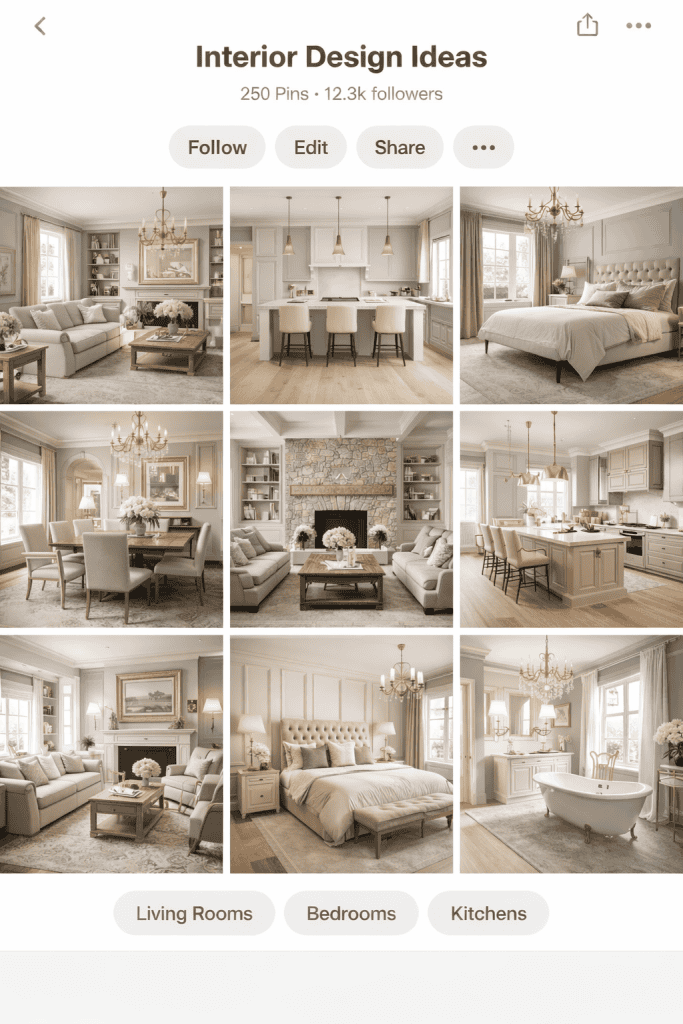
The real reason boards feel chaotic
Most style confusion isn’t about having too many tastes, it’s about not separating what photographs well, what trends well, and what you actually love (and supports your everyday life).
Once you start filtering your Pinterest boards through that lens, it stops feeling overwhelming and starts feeling useful and inspiring.
If your board feels messy right now, that’s not failure. It just means you’ve gathered information.
Now you get to edit it, and editing is where your style starts to show up.