
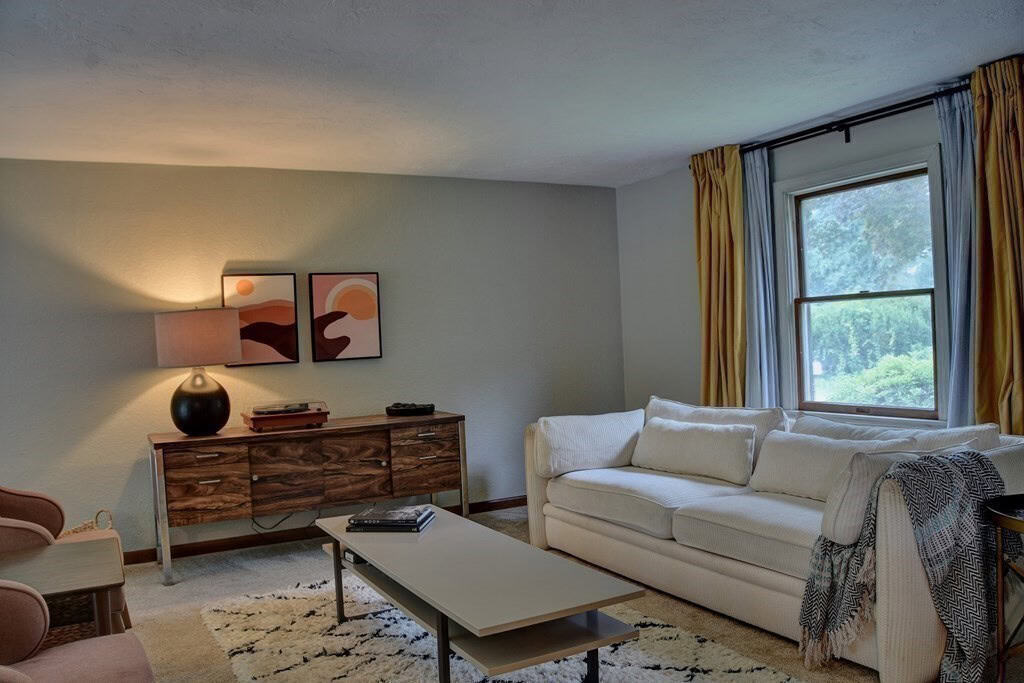
It’s unbelievable how much decluttering reduces stress, saves time, money, and makes life at home easier. It also makes decorating easier.
When I first started decluttering, like 13 years ago, it changed everything for me. Keeping the house clean was not only possible, it was quick and easy. I stopped wanting to buy cute new things, so it saved money too.
Joshua Becker was a guest on a podcast back then and he told a story about how he would have to take a whole day cleaning out the garage (regularly), and realized he could have been spending time with his kids who were currently off playing by themselves. I don’t have kids, but it really got through to me. We have all this stuff that very rarely gets used, takes up space, but also takes whole days at a time, just to maintain.
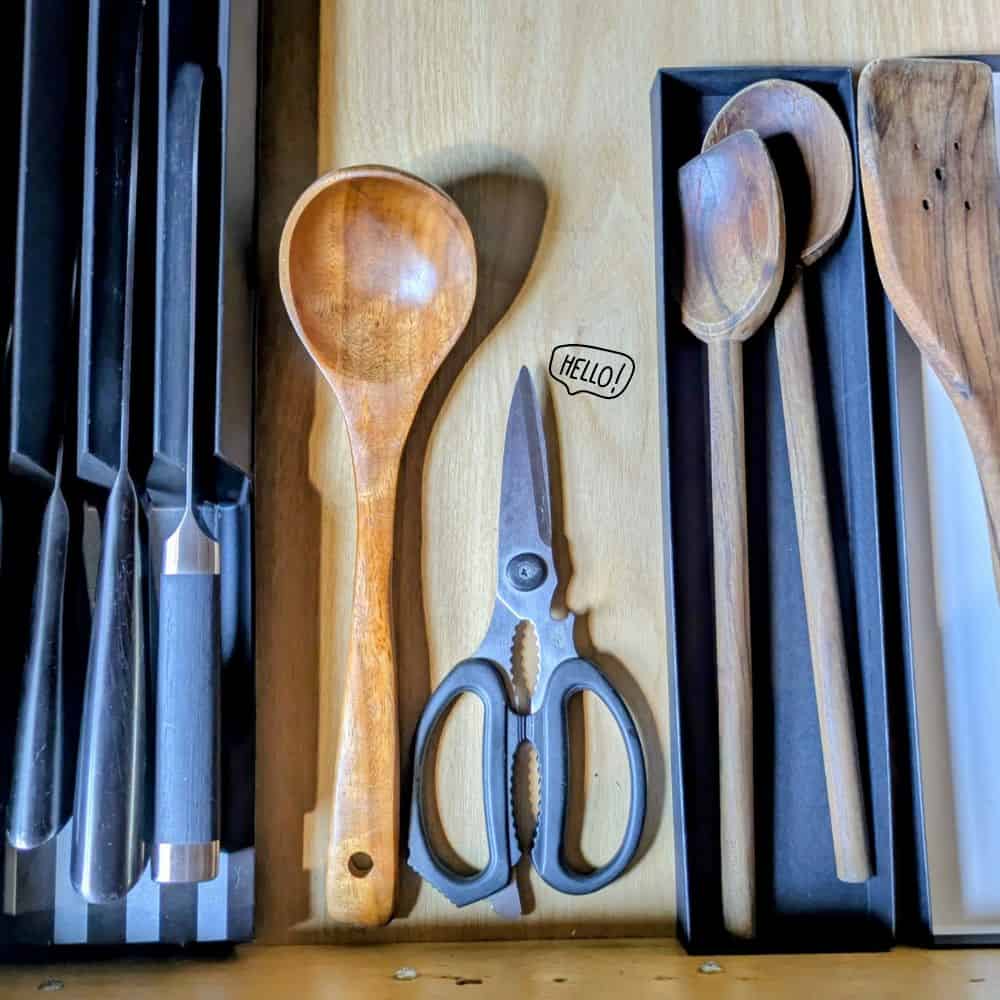
I got home and that was it. I grabbed the whole box of trash bags and started filling them for a yard sale. It took time, but the benefits started instantly. I could actually find things I needed (hello, scissors!) because the drawers weren’t full of other things hiding them. (Also…goodbye other 3 pair of scissors that were purchased because we couldn’t find the first ones.)
Easier to clean
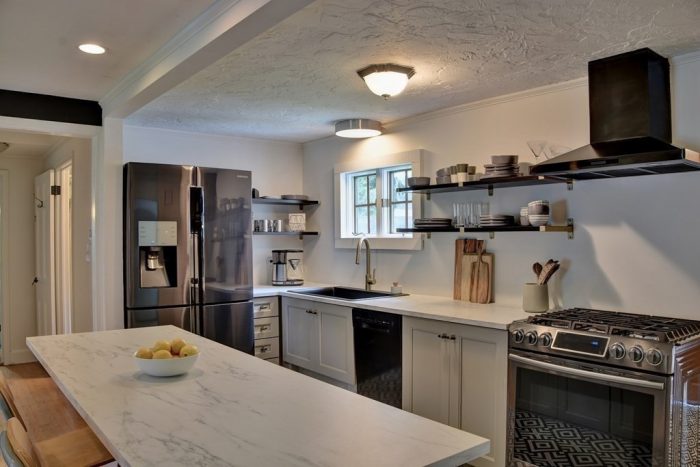
When cabinets are packed full and everything has to be put away just right, it adds a lot of friction. And our brains know that. So when we’re not full of energy, it’s easier to just leave things on the counter and deal with it later.
When we simplify what’s in those cabinets and make sure everything has a lot of room, our brains don’t see an extra step, it’s just as easy to put it away as it is to leave it out.
Martha Stewart always said “tidiness begets tidiness”, and the opposite is true too, stuff out (because it’s not easy to put away) invites you to leave more stuff out.
Once things are easy to put away again, it’s also very easy to clean because you don’t have to move stuff out of the way. You don’t have to spend the first 30 minutes tidying just to vacuum or wipe down the counters.
Home-keeping no longer feels like a full-time job.
You stop wanting to buy things
Like I mentioned above, I stopped wanting to buy new things. It wasn’t deprivation, I admired them on the store shelf, and happily went on my way. Before, I always had an idea of how something could be used, especially if it could hold my other stuff.
This was just a natural side-effect too. Not planned or expected. I just naturally had everything I already wanted at home and I didn’t want to go back to the previously-stressful state of the house.
Your home automatically looks better
Once the excess stuff is out, the nice things you do keep get more of the spotlight.
In design (of all sorts, not just homes), the eye always needs a place to rest. It’s called white space. When there is too much going on, the brain doesn’t know where to focus, so everything you have is just a distraction from everything else. (See the “Less stress” point!)
When your home is simplified, your eyes naturally go to one area at a time and can appreciate it.

You save money
Again, like I mentioned above, you will most likely lose the desire to buy new things (even “useful” things), which is one way simplifying and decluttering saves you money.
You won’t need to go buy new storage baskets or bins to organize all the stuff already there.
Another factor is that once you simplify, you’ll be able to find things, so you won’t need to go buy duplicates of what you already have. Think of how much that can apply to pantry items and groceries that go bad, or we don’t realize we already have 6 extra jars of tamari at home, so we buy another one (yep, I did that–that stuff is expensive!).

Plus, if you’re one of the 14.5 million households in the US that rent a storage unit, you could save an average of $1,000 a year (not to mention the time and stress it takes to have that extra stuff). There are more than 50,000 self-storage facilities nationwide…more locations than all Subway, Dollar General, and CVS outlets combined. Most of us just have more stuff than we need or could even use.
You’re less stressed
I was amazed at this one. I had no idea how much the “visual noise” of all the excessive stuff was causing “mental noise”. The house became so much easier to truly relax in (not just sit down, but actually chill). See the note above about your house looking better.
And you know why? Here’s the cool (if you’re a nerd like me) scientific explanation from a Princeton University Neuroscience Institute study:
They used MRI scans and found that clutter literally competes for neural representation in your visual cortex, limiting your brain’s ability to process information, reducing focus, increasing cognitive overload, and impairing working memory. People in clutter-free environments were more productive and less irritable and distracted. 😲
This becomes even more important if you or someone in your home has ADHD.
Common objections
I’ve been shouting from the rooftops about simplifying for all these 13 years, so I’ve heard all the objections (and had some of them myself).
Is this just “minimalism”?
No. Minimalism can have such a nebulous definition. Many people hear it and only think of a nearly empty white room…that’s definitely not it. This is why I use the word “simplifying”. It’s not about numbers of items (though that can be a way to make things fun and motivate yourself), it’s about not having more than you need. And it’s amazing how many things we think we need. I thought I needed almost everything in my house. Turned out, I rarely used/didn’t like about 75% of the things I owned.
It’s simplifying. Getting rid of the things you don’t need/want/use to make life easier, the house prettier, the bank account bigger.
I don’t want an empty house
Me either! Especially when we love just being in a pretty place. Thankfully, it’s not about being empty. What I found was that I had tons of things I “loved” that “made me happy”, all over. When I simplified, my decorating became much more intentional, and felt much more meaningful. I got to decorate with beautiful things that actually reflected my true style, AND meant something to me. And those things got to shine without being drowned out by all the extra cute things that I thought were adding to, but were actually taking away from.
I might need it some day
True, you might. And this is one objection that has tended to hang on for me as a knee-jerk reaction, even all these years later. But there are a lot of ways to look at this one.
One way is to think about how easy or difficult it would be to replace. Then compare that to the “costs” of keeping it around (less space in your kitchen cabinets, more hunting through full drawers, more stress when you see it on the shelf, a harder-to-clean house, etc).
Honestly, I’ve never missed anything I got rid of. If I needed it, I would borrow one from a friend or neighbor. OR go to the thrift store and buy one, then take it right back (or sell it online) when I was done. So easy, and actually pretty fulfilling.
It’s wasteful to get rid of good things
It does feel that way, but let’s flip that thinking.
It’s much LESS wasteful to give or sell those good things to someone who is actually going to use, appreciate, love those things. There are so many people who have basic needs they can’t meet right now. A lady in the next neighborhood whose vacuum cleaner broke and she just doesn’t have enough money for a new one. Wouldn’t it serve everyone (including the thing) to get that extra unused vacuum cleaner out of the garage and give it to her?
Even stained old towels are greatly appreciated at your local dog shelter. Instead of taking up space in the back of your cabinet, there could be a sweet dog who needs comfort and now has his own “blankie”.
I paid good money for that!
You did. And it might even have been a sacrifice for you to do so. But here’s the thing: keeping the item does not bring the money back. When you purchased it in the first place, did you intend for it to be an investment? Or were you happy to hand over the cash, knowing you weren’t going to get it back?
This was a tough one for me, but I had to stop and think logically. The money is long gone. Why continue to sacrifice for it, not money, but the peace and the easier life I want because of it? Either way, the money’s gone. Of course many things can still be sold and you’ll get a little bit back for them. Which you can look at as a surprise bonus, because I bet when you first purchased that coffee machine for $100, you weren’t thinking, I can sell this for $20, you were just happy to part with that $100. Bonus money!
My family will never go along with it
This is totally normal. Change is hard. I love what Dawn from the Minimal Mom teaches: treat it like an experiment that you’re trying out. You don’t necessarily have to throw things away right away, you can put them in boxes in the basement (that’s what I did when I started) and it would remove that initial fear-driven reaction for them.
Try to sell them on it. You can gamify it for the competitive ones, share stats and facts for the logical ones, inspiration photos for the visual ones…you know how they think! Just try to meet them there.
And of course, share with your family why it’s important to you. If they love you, they will at least think about how important it is for you to stop feeling overwhelmed by your house.
I can’t get rid of family heirlooms or sentimental stuff
I’ve been there too. I only have one family heirloom and it’s something I love, so I’m not getting rid of it.
But I have decluttered things that were special to me. Similarly to my point under being wasteful, there are probably many people out there who would use and appreciate those things.

If it’s a family heirloom: are there other family members who would love to have them? Would the family member you inherited it from be happy knowing that you didn’t really want it, and you’re just letting it take up space and cause stress?
Whenever I have something special I need to let go of, I like to take a picture of it, print it out, and then let it go to someone who will use and appreciate it.
I don’t have time
It does take time to go through your whole house and declutter. But two things:
- It doesn’t have to be done all at once, you can literally just devote 60 seconds at a time to it. Set a timer if you need to and open one drawer that’s overstuffed. See how much you can get out in literally 60 seconds. You’ll be surprised.
You can also take advantage of little waiting moments through the day. Coffee’s brewing? Instead of picking up the phone, open a cupboard. Commercials on? See what you can pull out of your TV cabinet. - Think of Joshua Becker’s garage example. Let’s say he was already devoting 4 days a year to cleaning the garage. If a day was spent decluttering the garage instead, he gained three extra days when it didn’t have to be cleaned.
If you like the idea of doing quick wins, I built a “Decluttering Slot Machine” to make it fun. Just say how much time you want to spend, spin, and it will give you a specific spot to declutter, a method of decluttering, and start a timer for you! You can also upload before and after pictures so you can admire your work build momentum. Go play here!